News
Our Mantyx team recently returned from SRS 2026 exhausted but energised.
The level of interest in Mantyx from leading hospitals, surgeons and global technology companies was incredible. What made the week especially valuable was how quickly the conversations moved beyond supporting a single procedure.
Again and again, the discussion turned to a much bigger question:
What could surgical intelligence make possible across an entire hospital organisation?
Beyond one operating room
Large hospital groups may have dozens of surgeons working across multiple sites, while patient demand and available expertise are rarely distributed evenly.
One hospital may have capacity. Another may have the specialist needed for a particular procedure. At a third site, patients may be waiting.
This creates both a planning challenge and a clinical one.
By combining telesurgery with live procedural context, hospital groups could use their surgical expertise more flexibly across locations. A remote expert would be able to follow how a procedure is progressing and understand when their support may be needed, rather than relying on a video feed alone.
That opens up a much broader role for surgical intelligence, helping hospitals make better use of their people, knowledge and capacity across an entire network.
What happens after surgery matters too
Another important conversation focused on the surgical report.
In the US, that report is more than a clinical record. It also helps start the coding, billing and collections process that follows a procedure. When the report is delayed, the steps that depend on it may be delayed too.
Because Mantyx follows the procedure as it happens, that same understanding could help create a structured draft of the surgical report afterwards.
For surgical teams, this could reduce time spent on documentation. For hospitals, it could help reports move forward faster and make the wider administrative and financial process more efficient.
It may be a less visible part of surgery, but it is an important one.
Exploring live telesurgery across borders
In conversations with Sovato and NVIDIA, we explored an ambitious live telesurgery concept involving procedures taking place simultaneously in different countries.
Mantyx would provide live procedural context from both operating rooms, allowing a remote expert to follow the progress of each procedure and see where their involvement may be useful.
A first demonstration could take place during the Surgical AI & Telesurgery Days in Ghent, laying the groundwork for a larger live event at NVIDIA GTC.
Connecting operating rooms is only part of the challenge. The real value comes from giving the remote expert enough context to understand what is happening in each procedure and act on that information.
A strong response to the Surgical RARP Copilot
On stage, Pieter De Backer presented our Surgical RARP Copilot and received an enthusiastic response from surgeons and technology leaders.
The questions were thoughtful and practical, with much of the discussion focused on how surgical AI can move from research into real clinical workflows.
Those conversations are especially valuable to us because Mantyx is being developed with direct input from surgeons and clinical teams who understand the realities of the operating room. Their feedback helps us focus on what is genuinely useful, what needs further work and what it will take for this technology to earn trust in practice.
The operating room itself is changing
One of the most striking demonstrations at SRS came from Dr. Martin Roche and the Peritas AI team.
They showed how cameras, AI and humanoid robots could help manage the activity surrounding a procedure, including moving equipment and materials around the operating room.
Seeing it live made the idea feel much more immediate. As these technologies develop, the OR could become a far more connected environment, with different systems responding to what is happening during the procedure and supporting the clinical team around it.
That depends on the technology understanding the surgery as it unfolds. This is where Mantyx can play an important role by providing the procedural context that other systems can use.
Feedback we will remember
One comment from a global medtech leader captured the level of interest we felt throughout the week:
“You’re in our top three of companies we want to work with.”
Hearing that was incredibly encouraging.
It showed that the need Mantyx is addressing is being recognised by the hospitals, surgeons and technology leaders helping shape the future of surgery.
We left Florida with exciting new possibilities and an even broader view of what procedure-aware intelligence can bring to surgery, both inside the operating room and across the wider surgical organisation.
Where could surgical intelligence take your programme?
Mantyx is building a voice-first, procedure-aware AI co-pilot for robotic surgery, designed to follow the procedure regardless of the robotic platform being used.
Interested in exploring a use case, discussing a potential collaboration or seeing Mantyx in action?
Mantyx joins the discussion at IEO Milan
For two decades, robotic surgery has helped redefine what is possible in the operating room. At IEO in Milan, a center with deep expertise in oncological robotic surgery, that progress became the starting point for a wider conversation about where the field is heading next.
The event brought together surgeons, engineers, and clinical leaders to reflect on robotic surgery as part of a larger shift toward digital, data-informed surgical care. The conversation looked beyond what robotic platforms have already made possible and turned to the data and clinical insight surrounding each procedure.
For Marco Mezzina, Computer Vision Engineer at Mantyx, that next phase starts with context.
From robotic precision to procedural understanding
Robotic platforms have brought greater precision, control, and consistency to complex procedures. Yet much of what happens during a case remains difficult to capture, compare, and learn from across procedures.
A more intelligent OR can make the surgical workflow easier to follow. It can help teams see how a procedure unfolds, where timing varies, and how insight from one case can support the next, from planning and intraoperative awareness to post-op review.
Clinical value of AI
What caught the room’s attention most was how AI could support the surgical team during the procedure itself. Surgeons wanted to understand how a system could recognize surgical phases, identify key events, and support the team without adding complexity or interrupting the flow of surgery.
The operational value became clearer as the discussion moved from clinical support to hospital performance. Better visibility into timing, variation, and workflow can help hospitals improve planning, case predictability, and OR utilization.
Bringing intelligence into the robotic OR
Mantyx is being developed as a real-time, voice-first AI co-pilot for robotic surgery, bringing procedure-aware intelligence into the OR without adding noise.
By making surgical workflow easier to follow and procedure data easier to interpret, Mantyx helps robotic surgery generate clearer clinical and operational value.
Stay connected
Want to follow what comes next in surgical AI?
Request a demo to discuss Mantyx with our team.
New leadership for the next chapter of surgical AI
Mantyx is proud to welcome Piet De Windt as Chief Executive Officer, marking an important step as the company moves from final development toward clinical readiness for its real-time AI co-pilot for robotic surgery.
Built with the support of ORSI Academy, Mantyx is developing procedure-aware intelligence designed to support surgical teams before, during, and after robotic procedures.
Piet brings more than 25 years of experience in data, software, AI, business intelligence, and deep tech company building. Most recently, he served as CEO of VaultSpeed, the data automation company he co-founded, leading it from inception to international commercial scale. He remains on the company’s board.
That experience now comes to Mantyx at a defining moment for robotic surgery.
Hospitals are under growing pressure to improve OR efficiency, procedure predictability, and the value they get from robotic programs. Surgeons are managing more information, more complexity, and more variation across every case.
Turning robotic surgery into measurable value
Mantyx is being developed to help relieve those pressures. Grounded in ORSI-rooted clinical expertise and tens of thousands of hours of documented procedural data, Mantyx connects planning, real-time intraoperative support, reporting, and performance insight across the surgical workflow.
For surgeons, that means better procedure prep, voice-controlled support and image manipulation in the OR while keeping surgeons’ hands and focus on the operation, and quicker post-op reporting.
For hospitals, it means more predictable procedure times, better OR planning, clearer workflow insight, and greater freedom across robotic systems.
Advancing the future of robotic surgery
With Piet as CEO, Mantyx gains the leadership, focus, and ambition needed to strengthen clinical evidence, build market trust, and move toward global relevance.
“The opportunity to build a European surgical AI company with global ambition is exactly the kind of challenge I wanted next,” said Piet De Windt, CEO of Mantyx. “Mantyx has the clinical roots, the technology foundation, the data, and the partners to help shape the next generation of robotic surgery. My focus now is on building the team, strengthening our partnerships, advancing our clinical evidence, and preparing Mantyx for the next stage.”
“We are thrilled to welcome Piet to Mantyx,” said Dr. Pieter De Backer, co-founder of Mantyx. “He brings the experience, energy, and company-building mindset we need right now. Mantyx was created from a deep belief in the future of robotic surgery and the role AI can play in helping surgical teams get more from every procedure. Piet understands that vision, and he has the leadership experience to help bring it forward.”
First public appearance as CEO
Piet’s first speaking event as CEO takes place this Wednesday at DeviceTalks Boston, where he will join Dr. Pieter De Backer for “From Vision to Incision: AI’s Real-Time Role in the OR.”
The session brings together leaders from NVIDIA, Mantyx, AZORG, and Infor for a live discussion and demonstration on how AI, interoperability, data infrastructure, and clinical expertise are beginning to reshape surgery in real time.
Follow Mantyx for the latest developments in surgical AI, robotic workflow intelligence, and the future of the intelligent OR.
After our presentation at the Surgical AI Days in Ghent, the news about Mantyx's innovative solution was picked up by several sources.
De Specialist (Interview): An innovative AI copilot for surgery, developed by a team affiliated with the Orsi Academy Ghent and AZORG Hospital Aalst, was presented last week for the world's first time. De Specialist spoke with developer and urologist Dr. Pieter De Backer.
VRT NWS (Video): Dr. Alex Mottrie performs surgery in Aalst hospital with the help of AI, doctors and engineers follow the scoop live from a conference in Ghent
TRT Haber (In Turkish): At a surgical event held in Ghent, Belgium, a voice-controlled Al assistant that provides real-time support to surgeons during robotic surgery was introduced.
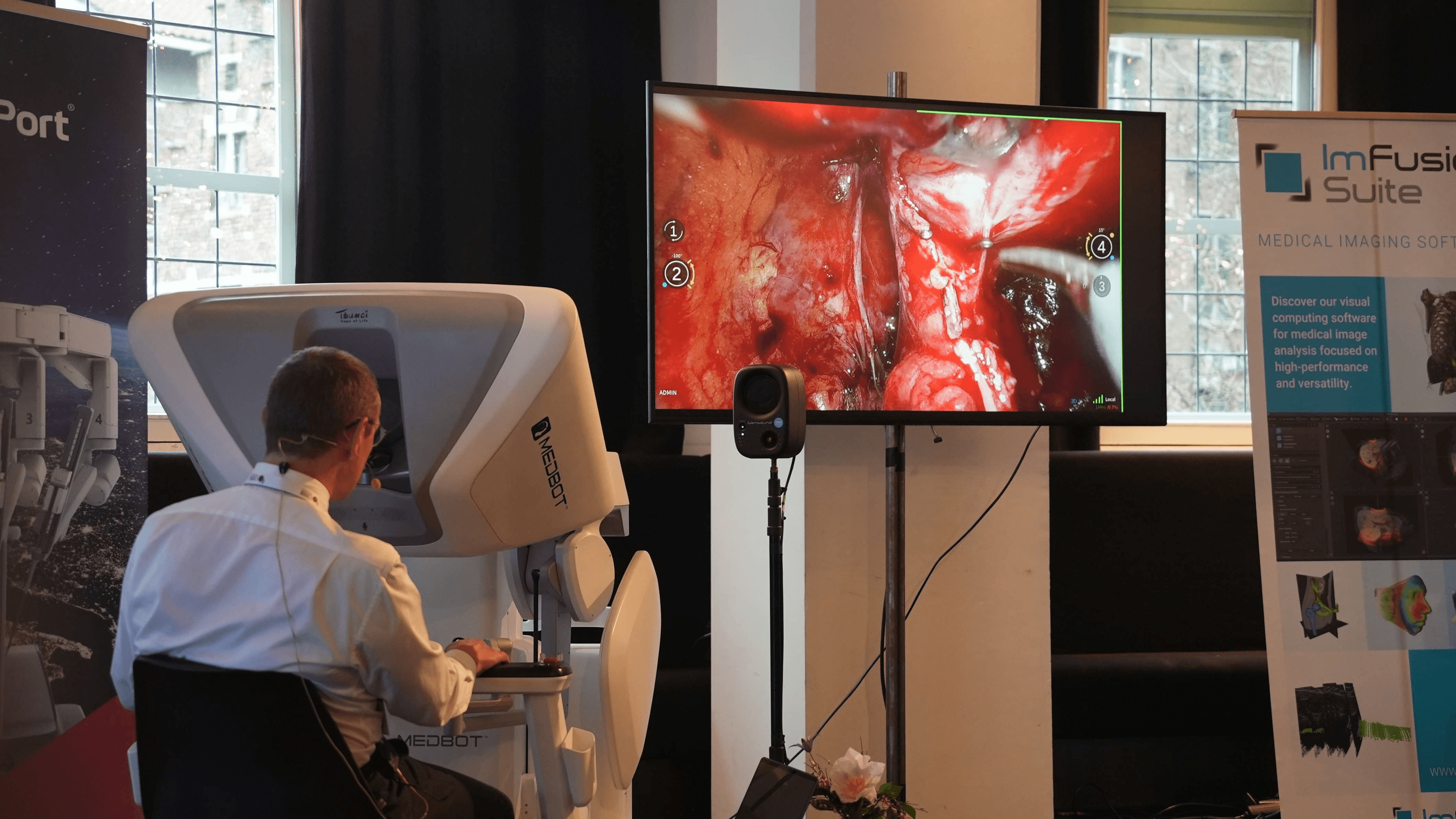
On 27 March, during the live surgical days in Ghent, Mantyx’s surgical co‑pilot was showcased in a live robotic procedure at AZOR Hospital in Aalst. The operation was assisted by a voice‑controlled AI co‑pilot, while experts simultaneously followed the case from a surgical AI conference in Ghent. The VRT news team of the national broadcaster covered this milestone.
Mantyx powers this new way of working: a surgical co‑pilot that understands the procedure in real time, recognises critical anatomy and phases, and automatically brings the right imaging and information to the surgeon without leaving the console. It is an assistant – not a replacement – designed to reduce cognitive load for surgeons and enable more predictable, efficient operating rooms.